
Monarch Business School Switzerland · Business Research
Research Methodology
The Monarch Standard Research Method
Perfecting Business Research From Methodology to Praxis
Academic snapshot and key insights
Managers often need to understand why a practice works in one setting and fails in another. Dr. Barsoum and Dr. Henderson present the Monarch Standard Research Method as a way to study such questions. It brings together literature triangulation, methodological triangulation and a ten-step research process.
- Compare how three fields of scholarship explain the same decision.
- Use early interviews to guide a second literature review and follow-up questions.
- Test whether an existing model accounts for what practitioners encounter.
1. What happens to a management idea at work?
Imagine a company that gives its branch managers authority to resolve customer complaints. The policy promises faster decisions. Yet a branch manager still calls head office before approving a refund. The written rule tells us who can decide. The phone call raises a different question. What makes someone willing to exercise that authority?
This hypothetical case illustrates the problem at the centre of the Monarch Standard Research Method. Management researchers study people who interpret rules, work within relationships and remember what happened the last time someone took a risk. An explanation that overlooks those conditions may offer a manager little guidance. Dr. Miray Barsoum and Dr. Jeffrey Henderson set out a way to investigate where an academic explanation holds in practice and where experience calls for a revision.
2. Different forms of triangulation
In the branch example, interviewing another manager, asking a second researcher to interpret the interviews, and examining the refund records would each strengthen the inquiry in a different way. The distinction lies in what the researcher varies. Table 1 of the paper identifies six possibilities.
- Data triangulation compares sources. Interviewing branch managers, frontline staff and head-office reviewers brings three accounts of the same approval process into view.
- Investigator triangulation brings several researchers to the same question. Two interviewers might interpret a manager’s hesitation differently and return to the transcript to see which reading the words support.
- Theory triangulation examines the evidence through several explanations. One theory might explain a call to head office as a response to incentives. Another might explain it as a response to colleagues’ expectations.
- Methodological triangulation combines methods. A researcher might analyse the refund policy, interview managers about recent decisions and compare their accounts with transaction records.
- Analytical triangulation applies different analyses to the same material. The researcher might code interview passages for recurring concerns, then reconstruct the sequence of events in each refund decision.
- Multiple triangulation combines two or more of these forms in one study. For example, two researchers could independently compare accounts from several stakeholder groups, combining investigator and data triangulation.
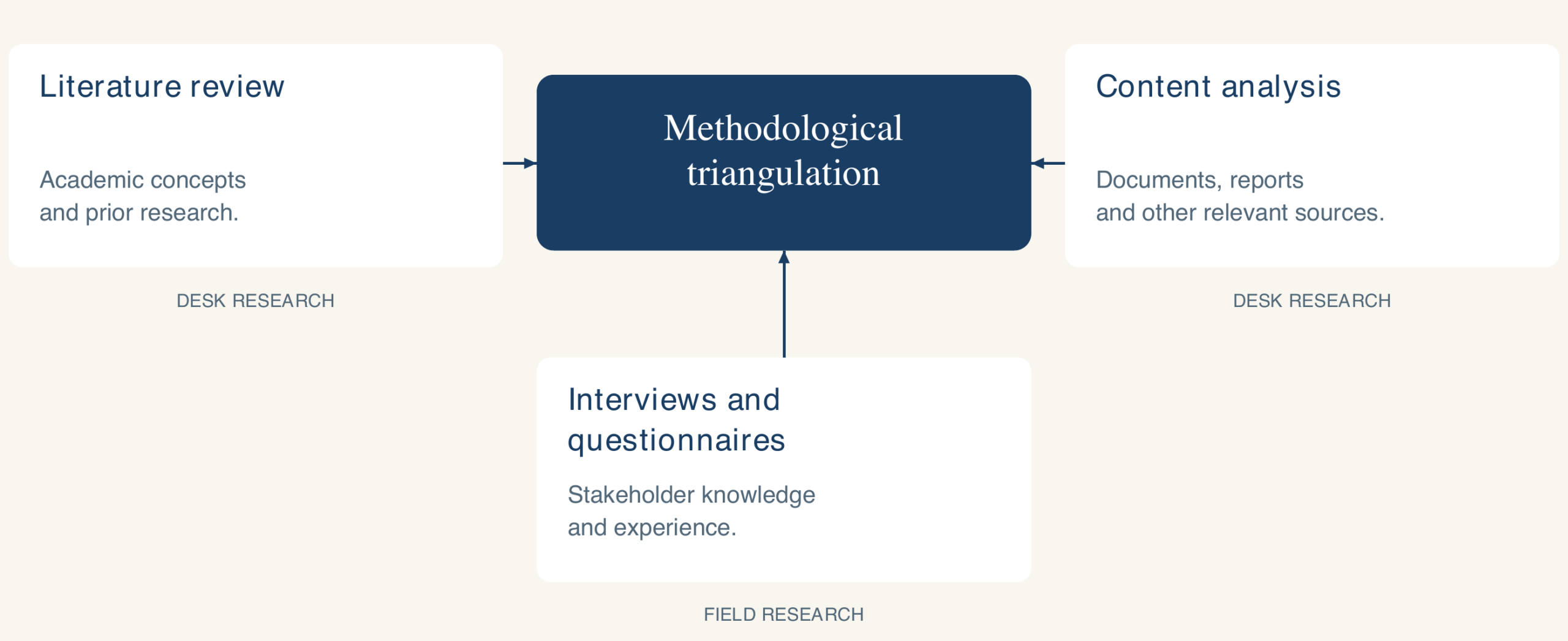
Methodological triangulation in the Monarch method
Figure 3 connects the literature review and content analysis with field interviews. Each answers a different part of the branch question. Scholarship suggests why people seek approval, the policy establishes who may issue a refund, and an interview can reveal what happened the last time a manager acted independently. If the three accounts diverge, the researcher has a focused question for the next interview.
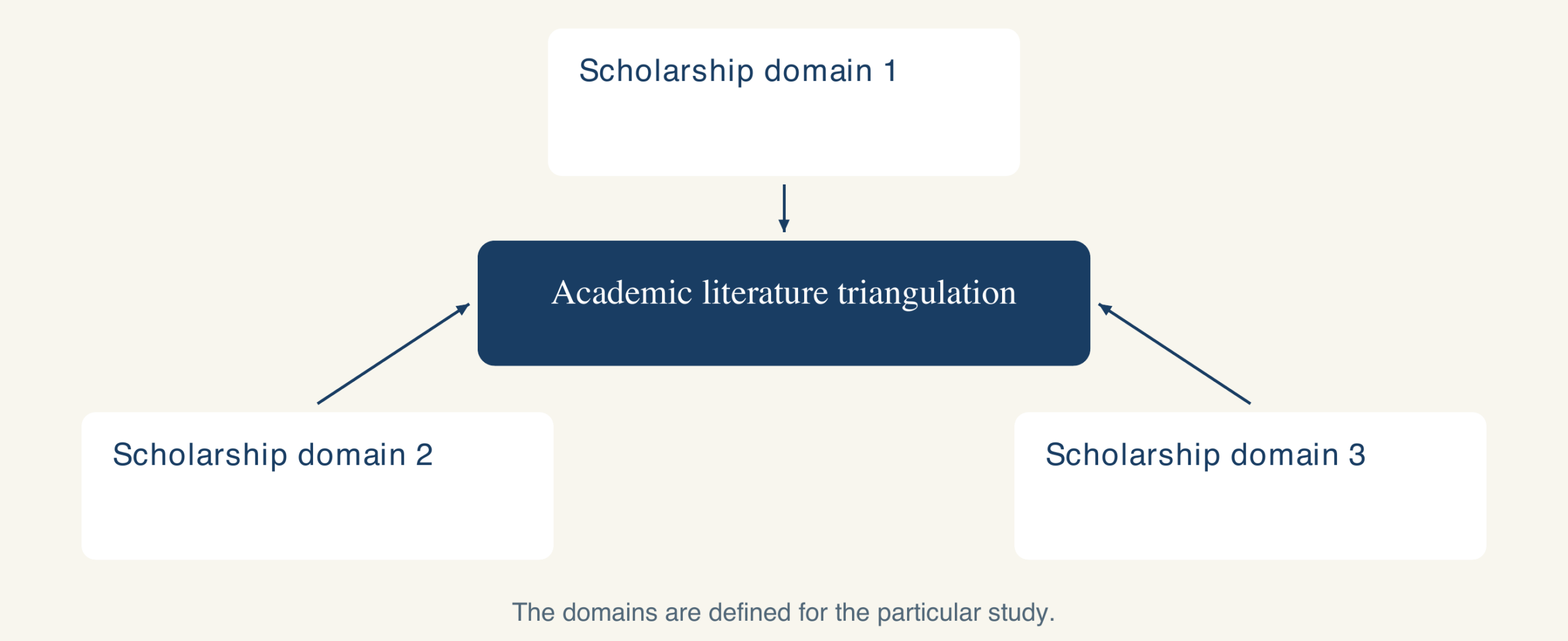
Literature triangulation in the Monarch method
Figure 4 moves the comparison inside the literature review. The researcher reads across three relevant fields to find where their explanations meet and what each leaves unanswered. In the branch example, organisational design explains who holds authority, managerial accountability explains who must justify a decision, and customer-service research asks what the delay means for the customer. Their intersection suggests a sharper research question: under what conditions does delegating refund authority actually shorten the customer’s wait?
3. The ten-step research process
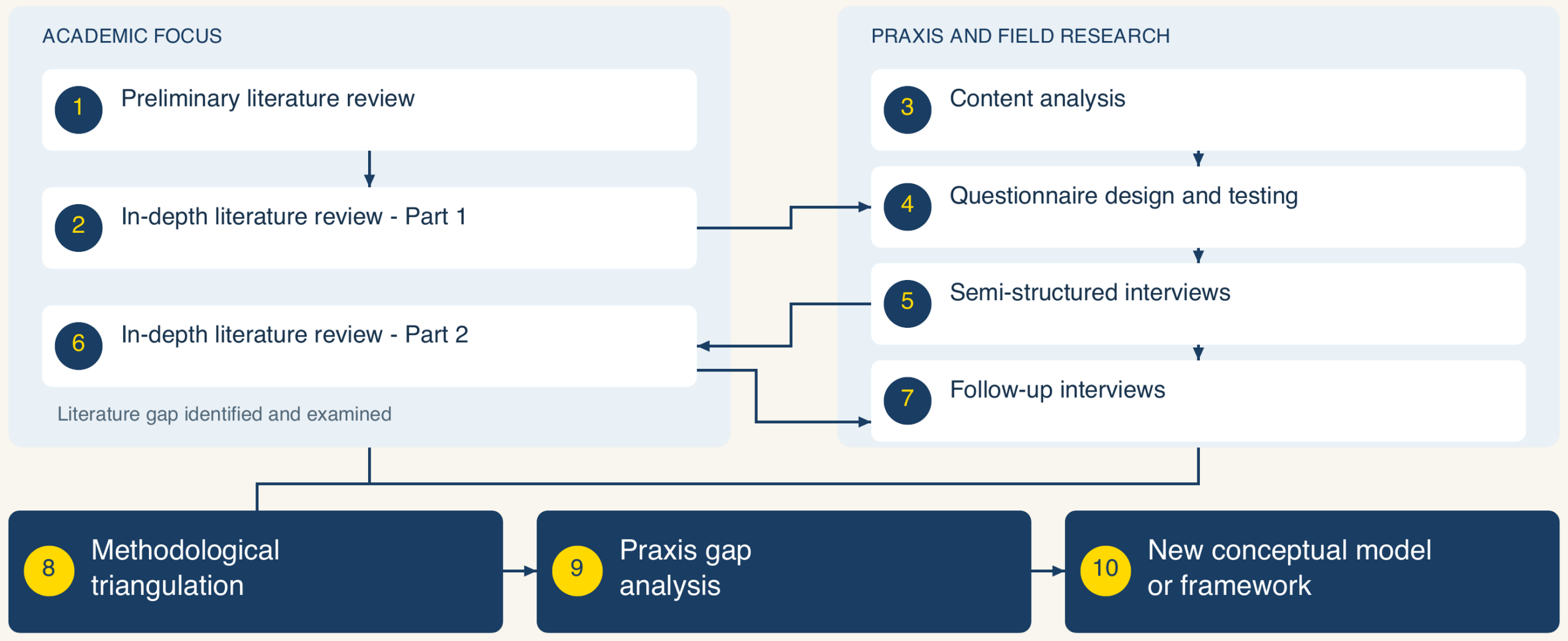
The ten-step process gives the two forms of triangulation a working sequence. Comparing three bodies of literature helps the researcher frame the question. Comparing scholarship, documents and interviews then tests how well the emerging explanation fits practice. The return to the literature after the first interviews connects those two tasks.
Finding the question between disciplines
The method begins with a preliminary review, followed by a close reading across three relevant areas of scholarship. In the branch example, a researcher might bring together work on organisational design, managerial accountability and customer service. Each field gives the researcher a different question to ask. Who holds decision rights? Who answers for a costly mistake? What does the customer experience while the decision travels up the chain?
Reading across those fields is what the authors call literature triangulation. Its value lies in the comparison. A study of decision rights might measure the authority formally delegated to a branch. A study of accountability might explain why managers seek approval even when they already have that authority. Read together, the two accounts help the researcher specify what remains unknown. That is a literature gap. It might concern a stakeholder whose experience is missing, a relationship that earlier studies assumed, or evidence that researchers have yet to collect.
4. Letting the first interview change the second
Once the provisional question is clear, the researcher turns to documents. An annual report may describe what executives hoped to achieve. A policy manual may show how they translated that aim into instructions. These sources help shape a semi-structured interview guide, which volunteers test for clarity, sequence and timing. The researcher then interviews people from the stakeholder groups closest to the question.
One of the most consequential choices in the ten-step process comes after those interviews. The researcher goes back to the literature. Suppose several branch managers mention the monthly review of refunded transactions. That detail gives the researcher a reason to revisit scholarship on oversight and to ask a more precise follow-up question. Can a manager recall a refund that drew scrutiny, and what did colleagues do differently afterwards? A second round of interviews with a subset of the original participants allows the researcher to pursue that lead across stakeholder groups.
This sequence gives practitioners a part in shaping the inquiry. Something a participant recalls can change what the researcher reads and what the next participant is asked. The paper also makes the terms of that relationship explicit. Participants give informed consent, their involvement remains voluntary, and the researcher protects their identities and responses.
5. What to do when the evidence disagrees
The next step brings scholarship, documents and interviews together. The authors call this methodological triangulation. Each source can expose a weakness in an explanation drawn from another. In the branch example, the manual might accurately describe delegated authority while the interviews accurately describe the cost of using it. Both accounts can be true. Their apparent disagreement directs attention to how decisions are reviewed after the fact.
Combining methods takes judgment. The paper acknowledges that methods can rest on different assumptions and produce conflicting results. Before drawing a conclusion, the candidate has to establish what each source can support. Was the refund policy in force when the manager made the call? Did the interviewee take part in the decision or hear about it afterwards? A transaction record might establish how long approval took while saying little about why the manager waited. Those distinctions matter even when the sources appear to agree.
6. From a literature gap to a practical contribution
Near the end of the process, the researcher asks a different question from the one that opened the review. How well does the available theory explain what people actually encounter? The authors call a consequential mismatch here a praxis gap. The final step is to assess the existing conceptual model and decide whether the evidence warrants retaining, adapting or replacing it.
The authors describe this collaboration as engaged scholarship. A branch manager can help frame the question at the outset by identifying the decision that needs explaining. Once the candidate has an explanation, the manager can help assess whether it accounts for the constraints staff face and offers guidance they could use.
For the branch manager, the difference matters. If the obstacle is a lack of authority, changing the approval limit might help. If the obstacle is what happens when a refund comes up for review, raising the limit leaves the original problem intact. The contribution of the research is an explanation precise enough to distinguish those possibilities, and clear enough for the people making the decision to examine for themselves.

Dr. Jeffrey Henderson
Dr. Henderson is Dean of the School and Professor of CSR and Business Ethics at Monarch Business School Switzerland. His work examines corporate responsibility and the ethical questions managers face, drawing on his experience in commercial real estate and consulting.

Dr. Miray Barsoum
Dr. Barsoum is Dean of Educational Development and Professor of Marketing and Entrepreneurship at Monarch Business School Switzerland. Her research examines how women start and sustain businesses in developing economies, with particular attention to Egypt.
