
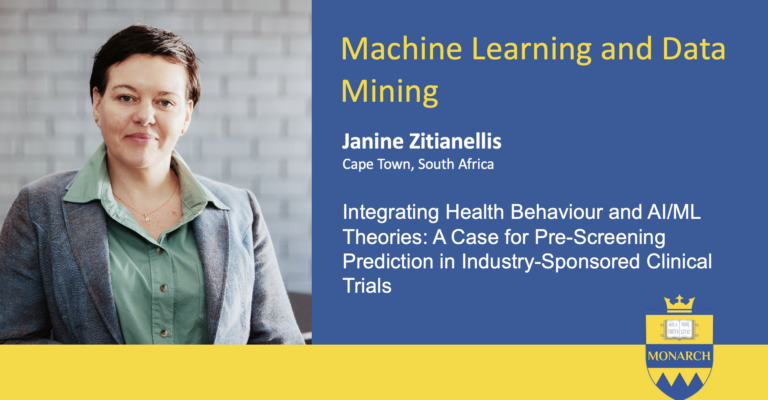
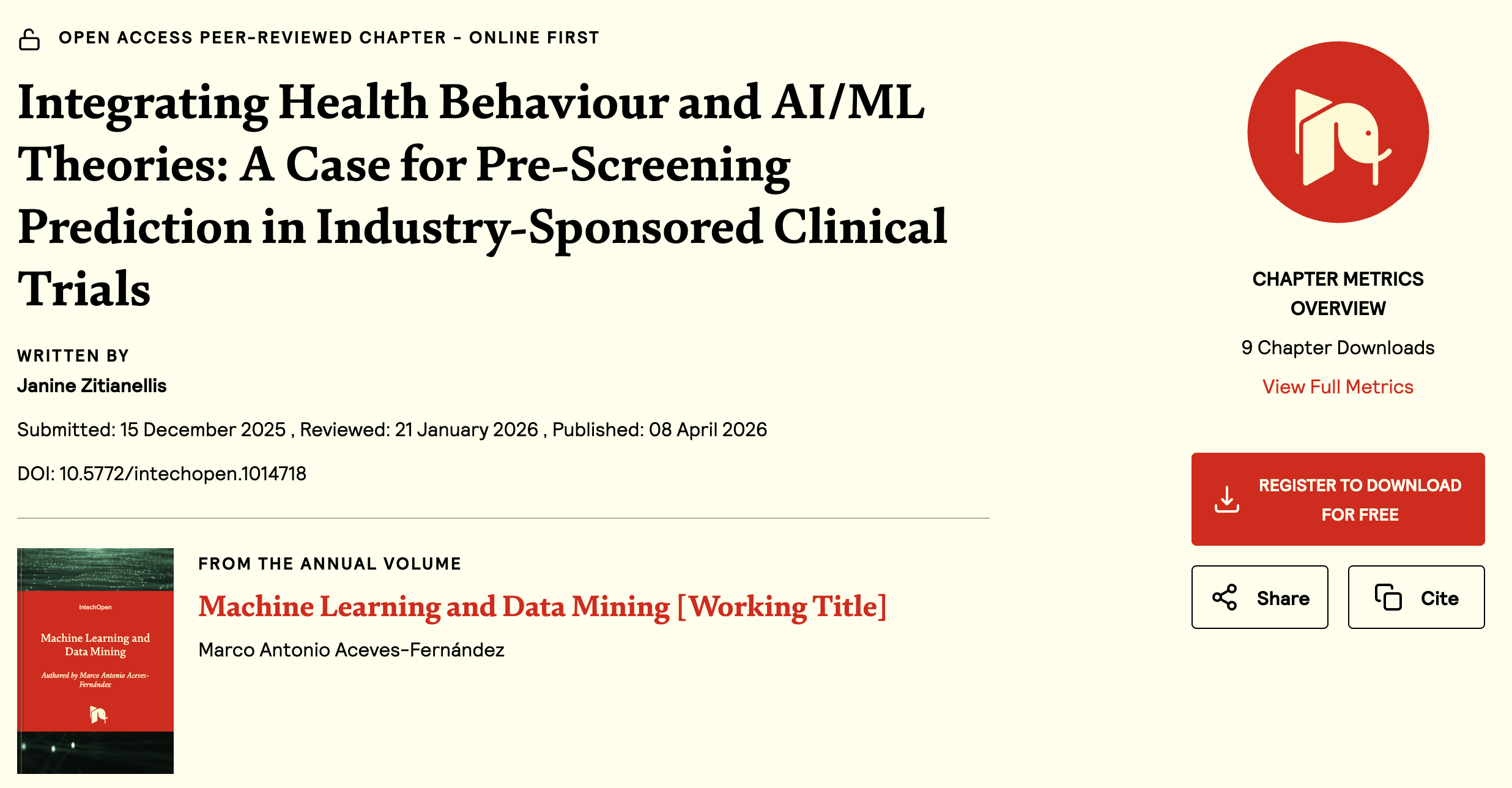

PhD Candidate Janine Zitianellis Publishes Book Chapter on AI/ML and Clinical Trial Recruitment

Monarch Switzerland is pleased to highlight the recent scholarly contribution of doctoral researcher Janine Zitianellis through the publication of her new peer-reviewed book chapter, “Integrating Health Behaviour and AI/ML Theories: A Case for Pre-Screening Prediction in Industry-Sponsored Clinical Trials”, published by IntechOpen as part of the forthcoming volume Machine Learning and Data Mining.

The chapter appears as part of the forthcoming volume Machine Learning and Data Mining and contributes to the growing international discussion surrounding the application of artificial intelligence, behavioural analytics, and predictive modelling within healthcare operations and clinical trial management.

A Research Focus on Clinical Trial Recruitment Challenges

One of the major operational difficulties within modern clinical research involves the efficient recruitment and screening of suitable participants for industry-sponsored clinical trials. Delays, participant attrition, and inefficient referral systems can significantly impact research timelines, costs, and overall trial success.

Janine’s research addresses this challenge through the development of a predictive framework that integrates behavioural science theories with machine learning methodologies in order to improve the quality and efficiency of patient pre-screening processes.

Rather than approaching recruitment solely as a technical or administrative issue, the chapter positions patient engagement as a complex behavioural phenomenon influenced by psychological, social, and temporal factors.

Integrating Behavioural Theory with Artificial Intelligence

A significant contribution of the chapter lies in its interdisciplinary integration of the Health Belief Model (HBM) with contemporary artificial intelligence and machine learning methodologies. Rather than treating patient recruitment solely as a statistical or operational exercise, the research incorporates behavioural and psychological dimensions into the predictive framework itself.

Using Large Language Model (LLM)-based Named Entity Recognition (NER), patient responses were analyzed and mapped to key behavioural constructs associated with the Health Belief Model, including perceived susceptibility, perceived severity, perceived benefits, and perceived barriers. These behavioural indicators were subsequently incorporated into predictive machine learning models using XGBoost classification techniques to improve the prediction of successful progression through phone-screening stages.

The chapter demonstrates how behavioural theory can substantially enhance predictive healthcare analytics by introducing human-contextual variables into machine learning systems rather than relying exclusively on demographic or procedural data. In doing so, the research advances a more human-centred and behaviourally informed approach to healthcare recruitment analytics while also illustrating the growing potential for interdisciplinary integration between behavioural science and AI-driven operational systems.

The Importance of Timing in Patient Engagement

The research additionally highlights the importance of temporal responsiveness within clinical recruitment systems. Through Kaplan-Meier survival analysis, the study identified a significant decline in patient responsiveness over time following referral. The findings suggest that the probability of successful patient contact falls below 50% approximately eleven days after referral submission. This insight carries important operational implications for healthcare organizations and clinical trial coordinators, emphasizing the need for adaptive engagement systems capable of prioritizing outreach during periods of peak responsiveness. The chapter therefore contributes not only to predictive modelling research, but also to operational strategy and healthcare process optimization.

Ethical and Social Dimensions of AI-Driven Healthcare Systems

Importantly, the research does not frame AI and machine learning merely as tools for efficiency enhancement. The chapter also explores the ethical and social dimensions of predictive healthcare systems, including concerns related to inclusivity, representation, and bias within clinical research participation. To address these concerns, the research incorporates social vulnerability indicators and minority representation variables into the predictive framework. This reflects an emerging movement within healthcare analytics toward more ethically informed and socially responsive AI implementation practices. The work therefore aligns technological innovation with broader concerns surrounding equitable healthcare access and responsible research design.

An Example of Interdisciplinary Doctoral Research

Janine’s publication represents an excellent example of the type of interdisciplinary and socially relevant doctoral research encouraged within Monarch Switzerland’s research environment. The chapter successfully bridges multiple academic and professional domains, including artificial intelligence, machine learning, healthcare management, behavioural science, predictive analytics, and clinical operations. Rather than approaching these disciplines independently, the research integrates them into a unified analytical framework capable of addressing real-world healthcare challenges through both technological and human-centred perspectives.

The work further illustrates the increasing importance of doctoral research that moves beyond narrow disciplinary boundaries in order to engage with complex contemporary problems. By combining behavioural theory with advanced predictive modelling techniques, the chapter demonstrates how applied research can contribute simultaneously to academic knowledge, operational improvement, and ethical healthcare practice.

This form of interdisciplinary synthesis reflects Monarch Switzerland’s broader academic philosophy, which encourages candidates to develop research that is not only methodologically rigorous, but also socially relevant, practically applicable, and responsive to emerging global challenges within professional and organizational environments.

About Janine Zitianellis

Doctoral Institute of Advanced Management StudiesPhD Candidate Janine Zitianellis is a creative and passionate professional with a proven track record of delivering results. She advocates for the ethical use of data and analytics, supporting data-driven decision-making and aiming to provide business value through actionable insights. Janine possesses a broad range of skills and deep expertise in advanced analytics, machine learning, data mining methodologies, data quality, and visualisation. Her successful career spans several industries, including pharmaceuticals and biotechnology, banking, credit and collections, retail, and manufacturing. In addition to her enthusiasm for data science, Janine is deeply committed to giving back to her community. She actively supports multiple initiatives, including Friends of Care Animal Welfare, and serves as an ambassador for The Warrior Project—an organisation focused on combating gender-based violence. Janine holds a master’s degree in data analytics and operations management from Arden University and has completed a postgraduate programme in data science and business analytics at the McCombs School of Business at the University of Texas. Currently, she is pursuing a PhD at Monarch Business School in Switzerland and will be defending her research in June 2026.

Latest Announcement

Monarch Switzerland Proudly Announces the Doctoral Graduates of 2025

Meet the accomplished professionals who successfully completed their doctoral studies in 2025, bringing deep leadership experience and rigorous scholarship to Monarch Switzerland.

View the Announcement

Latest Announcement

Monarch Switzerland Proudly Announces the Doctoral Graduates of 2025

Meet the accomplished professionals who successfully completed their doctoral studies in 2025, bringing deep leadership experience and rigorous scholarship to Monarch Switzerland.

View the Announcement