
MONARCH GLOBAL RESEARCH INSTITUTE
PhD in
Leadership
INQUIRY · LEADERSHIP · CONTRIBUTION
Examine how leadership works. Advance how it is understood through sustained scholarly inquiry, critical reflection and individual faculty supervision.
PROGRAMME BROCHURE · SEPTEMBER 2026
LEADERSHIP AS A FIELD OF INQUIRY
Beyond the practice of leading.
Towards a deeper understanding.
How is leadership constructed, interpreted and enacted—and what does it mean for the people and institutions it shapes?
36 or 60 months
Standard and extended pathways support different study paces while retaining the same supervision standards and degree outcomes.
Flexible, faculty-guided study
This doctoral program may be completed fully online, including the doctoral defence. No relocation is required. Candidates may select an in-person doctoral defence when offered by Monarch. Study is asynchronous, with individual supervision and milestone-based academic review. Entry is monthly, subject to admission.
A distinct scholarly purpose.
Situated within Monarch’s PhD in Business Research framework, the PhD in Leadership provides a structured environment for examining leadership through interdisciplinary and comparative perspectives. Candidates engage with its human, ethical and strategic dimensions across organisational and societal settings.
The programme draws on the European research-degree tradition of supervised inquiry, methodological rigour and original scholarly work. Leadership is studied as a complex phenomenon shaped by culture, cognition, institutions and systems.
Advance leadership knowledge.
The PhD emphasises theoretical development and an original contribution to knowledge. Candidates whose primary interest is applied leadership practice may also explore Monarch’s Doctor of Leadership.
YOUR DOCTORAL JOURNEY
From an important question
to an original contribution.
Develop conceptual clarity, methodological coherence and research independence through a sequence of faculty-guided milestones.
01 · Prepare
Build research-design, academic-writing and critical-thinking skills. Engage with leadership literature and appropriate research methods.
02 · Define
Frame your research problem, theoretical foundation and methodology. Define assumptions, limitations and scope for formal proposal review.
03 · Investigate
Undertake sustained inquiry and refine your analysis and theoretical positioning through regular supervisory dialogue.
04 · Synthesise
Bring your findings and argument together in a substantial dissertation, refined through successive drafts and feedback.
05 · Contribute
Submit your dissertation for formal academic evaluation and consider appropriate opportunities for publication and scholarly dialogue.
Where might your inquiry lead?
Leadership and ethics; governance and institutional life; culture, identity and influence; organisational change; cognition and lived experience; systems and societal contexts.
These are illustrative starting points, not prescribed projects. Your topic may be interdisciplinary or highly specialised. Scope and methods are refined through proposal development, academic review and supervisory fit.
YOUR SCHOLARLY CONTRIBUTION
Develop an independent voice
in leadership scholarship.
Critical theoretical engagement
Examine leadership and governance through multiple theoretical and interdisciplinary perspectives.
Methodological discipline
Develop research design and qualitative or interpretive competencies, including lived-experience inquiry where appropriate.
Original contribution
Construct a coherent, defensible argument that advances understanding in a defined research domain.
Scholarly communication
Strengthen academic writing, reflective theory–practice dialogue and your capacity to engage with research audiences.

Dr. Louise Delaney · Ireland
PhD in Business Research – Doctor of Leadership
Drawing on more than twenty years of senior management experience in Ireland’s multinational technology sector, Dr. Delaney examined leadership culture as an antecedent to innovation in American multinational technology subsidiaries in Ireland.
Her qualitative study used interpretative phenomenological analysis to explore leaders’ lived experiences and identify structural, cultural and adaptive enablers of innovation. Her work illustrates leadership scholarship within the wider Monarch research community.
Candidates can build their scholarly identity through academic dialogue, conference participation and opportunities to contribute to the Monarch Research Paper Series.
PROGRAMME PROFESSORS
Perspectives that deepen
leadership inquiry.
Two programme professors bringing complementary perspectives on leadership and organisational life.

Dr. Donald York
Professor of Leadership Studies · Dean of Student Development
Dr. York holds a D.Phil. and M.Phil. in Business Research with distinction from Monarch, an MA in Counselling & Spirituality from St-Paul University, and a BA in Behavioural Neuropsychology and Graduate Diploma in Leadership from McGill University.
His interests span leadership, spirituality, organisational culture and group dynamics. An experienced research supervisor and dissertation reviewer, he holds Chartered ABS’s Certified Management & Business Educator designation.
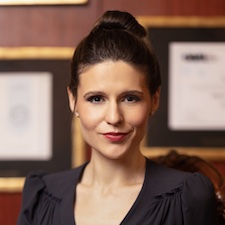
Dr. Karina Ochis
Professor of Management · Associate Dean of Student Development
Dr. Ochis holds a dual doctorate—PhD and Doctor of Applied Leadership—and an M.Phil. in Business Research from Monarch, an MA in Political Marketing from Rome Business School, and a BA in Politics from Queen Mary, University of London.
Her research explores multigenerational leadership, personal branding and succession management, particularly intergenerational conflict and younger generations in the workforce. An international speaker, including at TEDx, she has featured in Entrepreneur and The Huffington Post.
PLAN YOUR DOCTORAL STUDY
Academic preparation.
Research potential. Clear purpose.
For reflective executives, academics, consultants, coaches and professionals who want to contribute to leadership knowledge.
Entry requirements.
Applicants normally hold a recognised master’s degree or equivalent and demonstrate capacity for independent, critical inquiry. Prior research or publication experience is advantageous but not required.
Experienced professionals with a bachelor’s degree may be considered upon the Dean’s recommendation where leadership achievements, responsibility and relevant professional development demonstrate preparation for doctoral-level study. The Academic Board reviews research potential and supervisory fit.
Master-in-Passing
Candidates completing all doctoral requirements receive the M.Phil. in Business Research in passing upon conferral of the PhD.
Master-in-Exit
Candidates concluding before doctoral completion may qualify for the M.Phil. by submitting a completed five-chapter master’s thesis and meeting applicable academic requirements.
Choose a study pace that fits your responsibilities.
The standard pathway is 36 months; the extended pathway is 60 months. Both retain the same supervision standards and degree outcomes. Optional on-site scholarly workshops provide further opportunities for engagement.
Discuss your academic preparation, research interests and study plans with Admissions before applying.
YOUR NEXT CONTRIBUTION
What leadership question
will you take further?
Bring your experience, intellectual curiosity and commitment to rigorous inquiry. Begin a conversation about how your research could deepen understanding of leadership, governance and organisational life.
Discuss your research interests →
Explore the programme →
Apply for the PhD →
MONARCH SWITZERLAND
Vorderbergstrasse 34 · CH-6318 Walchwil, Zug · Switzerland
umonarch.ch · administration@umonarch.ch
PhD IN LEADERSHIP · / 7
Print on A4 at 100% scale with background graphics enabled and browser headers and footers disabled.