Understanding the Doctoral Journey at Monarch: From M.Phil. to Dual Doctoral Degrees
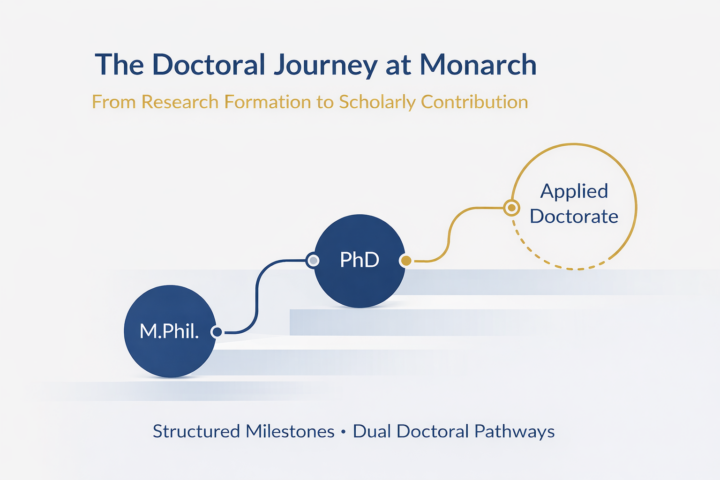
For a more detailed exploration of these pathways, readers are invited to review the dedicated pages on the Master-in-Passing (M.Phil.) and Dual Degree Pathways , where the academic structure and progression are examined in greater depth.
The Doctoral Journey as Structured Progression
Doctoral education is often misunderstood as a singular objective: the completion of a dissertation culminating in the award of a PhD. While this view captures the final outcome, it overlooks the intellectual journey that precedes it: one that involves the gradual formation of research competence, methodological discipline, and scholarly identity.
At Monarch Switzerland, doctoral study is intentionally structured to reflect this developmental process. Rather than treating the PhD as a single undifferentiated achievement, the program recognizes that becoming a researcher occurs through stages. These stages are not only pedagogical but also academic, forming a coherent architecture that supports both progression and aspiration.
This structure is most clearly expressed through three key elements: the Master-in-Passing (M.Phil.), the Master-in-Exit, and the Dual Doctoral Degree Pathways.
The Master-in-Passing (M.Phil.): Recognizing Research Formation
The Master-in-Passing (M.Phil.) represents a formal academic milestone within the doctoral journey. It is not a separate degree program, nor an optional add-on, but an integrated recognition of the candidate’s development as a researcher. At this stage, candidates have demonstrated the ability to:
- formulate a viable research inquiry
- engage critically with academic literature
- justify methodological approaches
- prepare for independent scholarly investigation
While the M.Phil. is formally awarded alongside the PhD, it reflects a prior achievement: the moment at which the candidate transitions from structured learning into genuine doctoral-level inquiry. This approach aligns with long-standing academic traditions, particularly within the British system and European research frameworks, where the development of research competence is understood as a meaningful achievement in its own right.
The Master-in-Exit: A Structured Academic Conclusion
Monarch also recognizes that doctoral study is a demanding intellectual commitment, and not all candidates will necessarily proceed to the final dissertation stage. For those who choose to conclude their studies earlier, the Master-in-Exit (M.Phil.) provides a structured academic outcome. This is not a fallback, but a formal recognition of substantial scholarly work completed within the program. Candidates pursuing this pathway are required to consolidate their research into a five-chapter Master-level thesis, prepared to the standards of academic submission. They may also elect to undertake a Master-level viva voce, presenting and defending their work before an academic committee. In this way, Monarch ensures that ll meaningful scholarly effort is recognized with academic integrity and respect.
Dual Doctoral Degrees: Extending the Research Journey
For candidates whose ambitions extend beyond the completion of a single doctoral manuscript, Monarch offers Dual Doctoral Degree Pathways. These pathways are structured sequentially. The first doctorate, typically the PhD, establishes a theoretical or conceptual contribution. The second doctorate, such as the DBA or Doctor of Applied Neuroscience in Management, builds upon this foundation through applied research, professional models, or practice-oriented frameworks.
This approach allows candidates to:
- deepen their expertise
- translate theory into practice
- produce a second, distinct doctoral-level contribution
Importantly, the two degrees are not pursued simultaneously. Each maintains its own academic integrity, ensuring that rigor is preserved at both levels.
A Distinctive Doctoral Philosophy
What emerges from this structure is a distinctly European approach to doctoral education—one that emphasizes progression, recognition, and intellectual formation. At Monarch, the doctoral journey is not defined solely by its endpoint, but by the stages through which the candidate evolves into a scholar. Each phase, whether preparatory, developmental, or advanced, plays a role in shaping the capacity for independent thought and meaningful contribution. This philosophy reflects a broader academic conviction: that research is not merely produced, but cultivated.
A Distinctive Model of Doctoral Education
The doctoral journey at Monarch Switzerland is designed as a structured and meaningful progression, from the development of research competence through the Master-in-Passing, to the completion of the PhD, and, where appropriate, to the extension of scholarship through Dual Doctoral Degrees. In making this structure explicit, Monarch offers something rarely articulated in higher education: a transparent and coherent academic pathway that respects both the rigor of doctoral study and the realities of professional life. Ultimately, the goal is not only to award degrees, but to form researchers—individuals capable of contributing thoughtfully, ethically, and meaningfully to the advancement of knowledge.
Dual Degree Pathways from Academic and Applied Doctorates
Monarch’s dual doctoral structure allows candidates to progress toward a second doctoral degree from either a theoretical or applied starting point.
PhD Pathway (Theoretical Foundation)Master-in-Passing: M.Phil. in Business Research Candidates pursuing the PhD develop a rigorous theoretical and conceptual contribution, grounded in qualitative inquiry and scholarly analysis. The Master-in-Passing (M.Phil.) reflects the transition into independent research formation. Upon completion, candidates may extend their work into a second applied doctorate, translating theoretical insights into professional models, frameworks, or applied research. PhD → Applied Doctorate (DBA / DANM / DOL) | DBA Pathway (Applied Foundation)Master-in-Passing: M.A. in Business Research Candidates pursuing the DBA or other applied doctorates focus on practical, real-world challenges, developing applied research and professional insight. The Master-in-Passing (M.A.) reflects structured research development within a professional context. Following completion, candidates may progress toward a PhD, expanding their applied work into a broader theoretical or conceptual contribution within their field of inquiry. Applied Doctorate → PhD (Theoretical Development) |
While the most common progression moves from theoretical research (PhD) to applied practice (DBA or equivalent), Monarch’s framework allows for the reverse pathway. Candidates may begin with applied research and later extend their work into a broader theoretical contribution, reflecting the institution’s flexible and integrative approach to doctoral education.