
Dr. Norman Madarasz to Present on the Philosophy of Multiplicity and Ontology at École Normale Supérieure in Paris
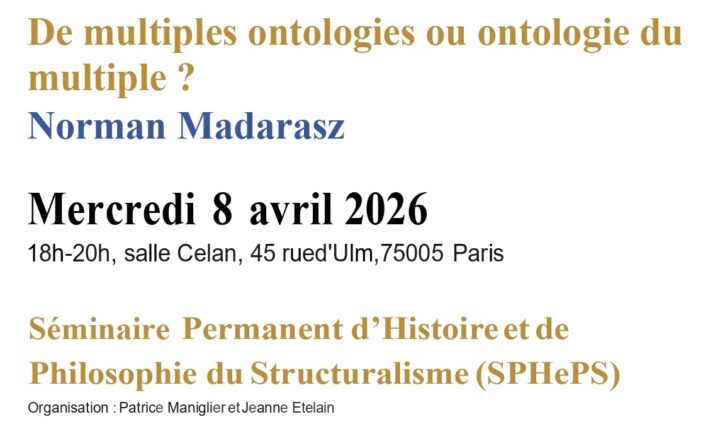
Monarch Switzerland is pleased to announce that Dr. Norman Madarasz, faculty member and scholar in philosophy and interdisciplinary research at Monarch Business School Switzerland and the Monarch Global Research Institute will be presenting his latest work at the prestigious École Normale Supérieure (ENS-PSL) in Paris.
The presentation will take place on Wednesday, April 8, 2026, as part of the Séminaire Permanent d’Histoire et de Philosophie du Structuralisme (SPHePS), hosted at the historic rue d’Ulm campus—an institution globally recognized for its intellectual rigor and its enduring contribution to philosophical and scientific thought.
Dr. Madarasz has been invited by Professor Patrice Maniglier, a leading figure in contemporary French philosophy and structuralist studies, reflecting the scholarly recognition of his ongoing contributions to the field.
Advancing the Philosophy of Multiplicity and Ontology
Focusing on developments in Brazil, France, and Canada, the research highlights the increasing influence of indigenous thinkers and anthropologists whose work challenges dominant scientific paradigms. These perspectives introduce alternative epistemological frameworks grounded in relationality, lived experience, and culturally embedded forms of knowledge, thereby expanding the boundaries of philosophical inquiry beyond traditional Western constructs.
At the heart of the study lies a fundamental question concerning the nature of ontology itself. Dr. Madarasz explores whether the diversity observed across these knowledge systems should be understood as evidence of multiple, distinct ontologies, or whether it instead points toward a deeper, unified ontology of multiplicity. This inquiry reframes the discussion by shifting attention from surface-level variation to the underlying structures that may give rise to such diversity.
To address this question, the research integrates philosophical analysis with ethnographic insight, creating a dialogue between abstract reasoning and empirical observation. In doing so, it also incorporates mathematical conceptions of multiplicity, which provide a formal lens through which the coherence and structure of seemingly disparate knowledge systems can be examined. This interdisciplinary approach enables a more nuanced understanding of how plurality operates within—and potentially converges into—a broader ontological framework.
From Structuralism to Ontological Integration
A central contribution of Dr. Madarasz’s work lies in its engagement with the intellectual legacy of structuralism, a tradition that has long emphasized variation, relational systems, and the differentiation of meaning across cultural and symbolic frameworks. While structuralist approaches have provided powerful tools for understanding how knowledge is organized and transmitted, they have also tended to foreground plurality and divergence as defining characteristics of human thought.
Dr. Madarasz’s research advances this discussion by reconsidering the ontological implications of such diversity. Rather than accepting multiplicity as inherently fragmented or irreducibly varied, his work explores the possibility that these apparent differences may be expressions of a deeper, underlying unity. This shift in perspective invites a re-evaluation of whether multiple ontologies truly exist as distinct systems, or whether they instead reflect different manifestations of a single ontological structure.
What distinguishes this inquiry is its grounding in ethnographic contexts, where philosophical abstraction is brought into dialogue with lived realities and cultural practices. By situating ontological questions within empirical settings, the research moves beyond purely theoretical speculation and engages directly with how knowledge systems operate in practice.
At the same time, the integration of mathematical notions of multiplicity introduces a formal and conceptual framework through which these questions can be rigorously examined. This allows for a reconceptualization of plurality—not as fragmentation, but as structured complexity—suggesting that what appears as diversity across knowledge systems may, in fact, reveal coherence at a more fundamental level of thought.
Monarch’s Commitment to Interdisciplinary and Global Scholarship
Dr. Madarasz’s invitation to present at the École Normale Supérieure stands as a clear testament to the depth and quality of scholarship cultivated within Monarch Switzerland’s academic community. It reflects an institutional commitment to intellectual inquiry that transcends disciplinary boundaries and engages meaningfully with global academic discourse.
At Monarch Switzerland, research is not confined within rigid academic silos but is instead encouraged to evolve through the integration of multiple perspectives, methodologies, and traditions of thought. This approach recognizes that the most compelling and impactful research often emerges at the intersection of disciplines, where philosophical reflection, empirical investigation, and lived experience converge.
Central to this philosophy is an emphasis on engaging with the complexity of real-world phenomena through a lens that is both analytically rigorous and contextually grounded. Scholars are encouraged to explore cross-cultural perspectives and to draw upon diverse epistemological traditions, ensuring that their work resonates beyond theoretical abstraction and contributes to broader intellectual and societal conversations.
Dr. Madarasz’s research exemplifies this orientation. By bridging philosophy, anthropology, and mathematical reasoning, his work reflects the type of integrative scholarship that Monarch seeks to foster: scholarship that not only advances academic theory but also deepens our understanding of how knowledge is constructed, interpreted, and applied across different cultural and intellectual contexts.
Academic Background
Dr. Madarasz is an international specialist in political philosophy, contemporary French philosophy and international geoeconomic relations. He is the author of six books and editor of ten collected volumes and translations. He has published over eighty essays and book chapters in peer-reviewed academic journals in English, French, and Portuguese over a broad range of questions related to ethics, economics, politics, history, religion, language, and logic. Dr. Madarasz has supervised over forty Masters’ and Ph.D. projects. He has been an invited speaker at a host of leading universities in Brazil, Uruguay, and France, in addition to lecturing in Canada, the United States, and Chile. In addition, Dr. Madarasz has been a frequent contributor to various news outlets, with think pieces on geopolitical and international affairs, BRICS+ and North/South relations. At the undergraduate level, he has been lecturer in the departments of Business Administration, Law, Philosophy, History and Literary Sciences in a host of universities.
Dr. Madarasz studied philosophy as an undergraduate at McGill University, where he graduated with honours in 1986. Thereafter, he studied at the Université Paris I (Sorbonne), Collège international de philosophie and Université Paris VIII (Vincennes à Saint-Denis), at which he earned the French Maîtrise, Diplôme d’études approfondies and, in 1999, the Doctorat (Mention très honorable avec félicitations du jury/Ph.D. Summa cum Laude). The latter two were achieved under the supervision of Alain Badiou, one of France’s most celebrated philosophers.
Over his twenty years experience as an academic, Dr. Madarasz was most recently Associate Professor in Political Philosophy and Linguistics at the Pontifical Catholic University of Rio Grande do Sul State, in Porto Alegre, Brazil (PUC-RS). From 2009 to 2012, he was director of the Department of Philosophy at Universidade Gama Filho, in Rio de Janeiro, following an invitation to act as Capes foreign visiting fellow in 2005-6. In 2011, he was awarded a Doctor of Literature degree from Monarch Business School Switzerland. In 2014, he acted as visiting scholar at the Universidad de la República (Udelar, Montevideo), and in 2022, Dr. Madarasz was Invited Capes/PrInt Fellow at the Université Paris VIII, where he presented a semester long seminar on Alain Badiou’s philosophical system.
Dr. Madarasz holds the position of Director of the Post-Doctoral program at Monarch Switzerland as well as Director of the Monarch Global Research Institute.
