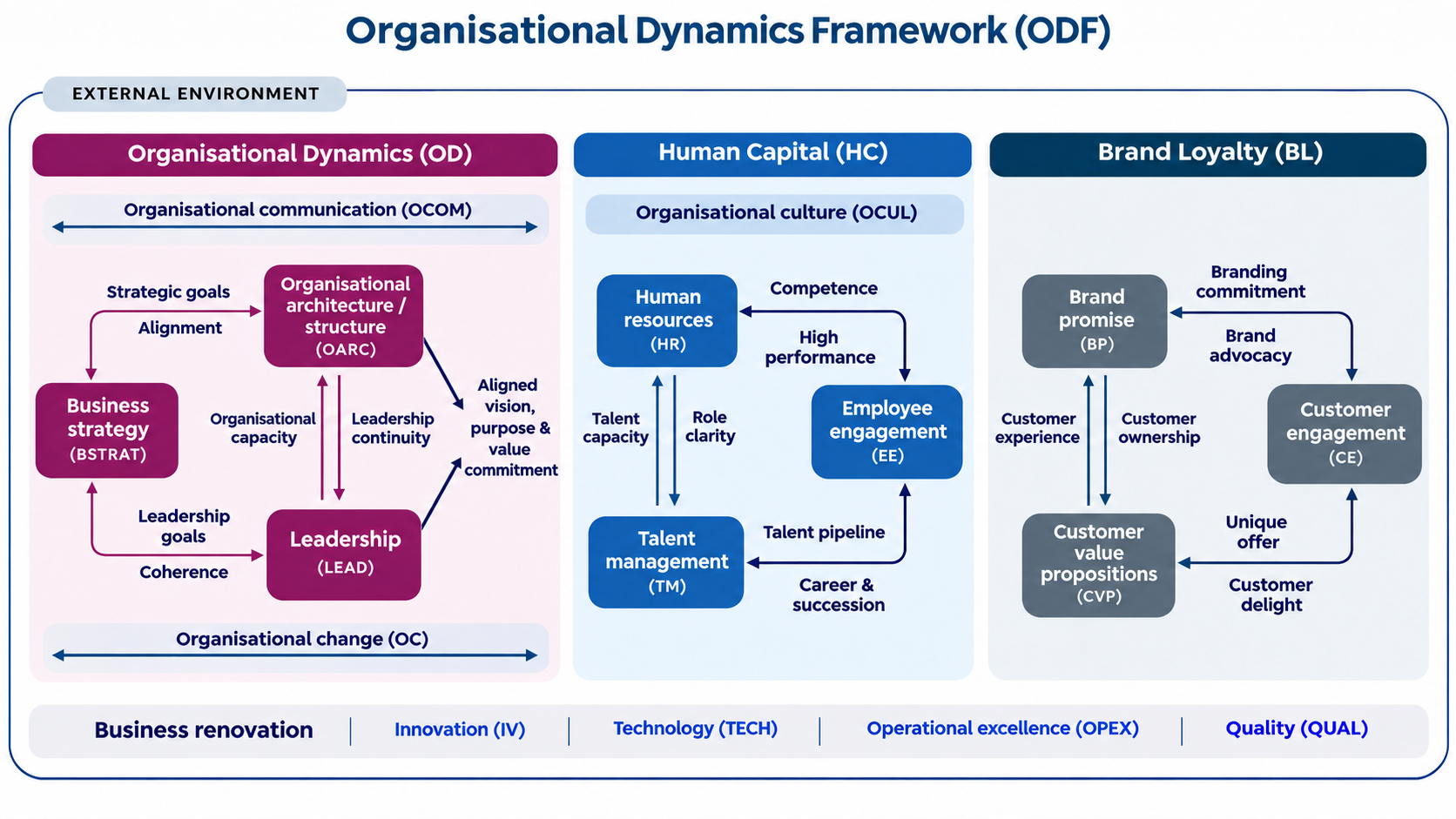
The organisational challenge
Organisations seldom lack strategy. Boardrooms develop strategic plans, executives establish priorities, consultants facilitate strategy workshops, and organisations produce sophisticated presentations explaining where they intend to compete, grow and differentiate. Yet an uncomfortable question remains. What happens to strategy after it leaves the boardroom? A strategy may be intellectually compelling and financially attractive, but it creates little organisational value unless people can translate it into decisions, behaviours and actions. This became an important insight from my doctoral research into Organisational Dynamics, Human Capital and Brand Loyalty, and it subsequently informed the Organisational Dynamics Framework (ODF). The central lesson is deceptively simple. Strategy becomes valuable only when the organisation can deliver it.
Business Strategy as an organisational capability
Business Strategy (see its positioning with the ODF in the Appendix) emerged as one of 20 interconnected themes within the ODF and was one of the more prominent themes within the research, representing 8.85% of the thematic weighting. However, its importance lies not simply in its prominence. The research positioned Business Strategy within a wider cluster of organisational conditions, including Organisational Dynamics, Organisational Architecture, Leadership, Organisational Communication and Organisational Change. This suggests that strategy should not be viewed as an isolated executive activity. Strategy establishes direction, but organisational architecture determines how work is structured. Leadership influences how priorities are interpreted. Communication translates strategic intent across organisational levels. Human Capital provides the capabilities required for execution. Operational Excellence converts strategic ambition into consistent organisational activity. Strategy therefore becomes part of an organisational system. This distinction matters because organisations can possess a strategy without possessing the organisational capability to execute it.
The relationship between strategy and organisational dynamics
One empirical relationship identified in the qualitative research was between Organisational Dynamics and Business Strategy, which co-occurred 13 times in the analysis. These co-occurrences should not be interpreted as statistical correlations or evidence of causality. Rather, they indicate that participants repeatedly linked strategic considerations to the broader dynamics of how their organisations functioned. This has an important managerial implication. A strategy cannot simply be introduced into an organisation and assumed to cascade successfully. Existing structures, leadership behaviours, communication patterns, organisational culture, decision-making processes, capabilities and competing priorities influence its execution. The question therefore needs to be supplemented to not just ask, “Do we have the right strategy?” but also, “Have we created an organisation capable of executing the strategy?” That is a substantially different leadership conversation.
Strategy must become human behaviour
Strategies do not execute themselves. An organisation may decide to become more customer-centric, digitally enabled, innovative, cost-efficient or geographically diversified. But each strategic ambition eventually encounters a human being who must do something differently. Someone must make a different decision. A leader must change a priority. A manager must allocate resources differently. An employee may require new capabilities. A team may need to collaborate across traditional organisational boundaries. Established processes may need to change. This is where Business Strategy connects directly with Human Capital within the ODF. Organisational Dynamics creates the enabling conditions; Human Capital becomes the behavioural engine that translates strategic intent into organisational action. Strategy therefore needs to answer more than “where are we going?” It must eventually answer, “What must our people be capable of doing differently for this strategy to succeed?”
The execution gap
A second important research relationship reinforces this argument. Operational Excellence and Business Strategy co-occurred 11 times within the qualitative analysis. Again, this does not establish causality. It does, however, illustrate how participants connected strategic direction with organisational execution. Operational Excellence should consequently not be understood merely as efficiency, process improvement or cost management. It represents part of the organisational machinery through which strategic intent becomes repeatable performance. Consider a business pursuing premium customer positioning. Its strategy may promise superior quality and customer experience. Yet if operational processes produce inconsistent quality, employees lack appropriate capabilities, decision-making is slow, or performance measures reward cost reduction at the expense of customer value, the organisation may systematically undermine its own strategy. The problem is no longer simply operational. It is a strategy-to-capability disconnect.
The customer experiences strategy differently
Customers rarely read corporate strategies. They experience them. They experience strategy through product quality, service reliability, employee behaviour, responsiveness, innovation and the organisation’s ability to deliver consistently what its brand promises. Brand loyalty should not be viewed exclusively as a marketing outcome occurring at the end of the customer journey. It can also be understood as a downstream organisational outcome. The pathway can be conceptualised as follows: Strategic Intent → Organisational Capability → Human Behaviour → Customer Experience → Brand Trust → Brand Loyalty. This is not intended as a rigid causal sequence. Organisations are complex systems in which relationships are dynamic and reciprocal. It does, however, give managers a useful way to examine how decisions made far from the customer can eventually become visible to the customer. The customer may never see the strategy. But the customer experiences whether the organisation can deliver it.
From strategy cascade to strategy translation
Organisations frequently speak about “cascading” strategy. The metaphor can be misleading. Cascading implies that strategy simply flows downwards from senior leadership through successive organisational levels. Yet strategy must do more than travel through an organisation. It must be translated. Corporate strategy must become organisational capability. Capability must become roles and accountabilities. Strategic priorities must influence resource allocation. Leadership expectations must become observable behaviour. Communication must create shared understanding. Performance measures must reinforce, not contradict, strategic priorities. For managers, this creates a practical diagnostic question, “What would need to be true organisationally for our strategy to succeed?” That question exposes assumptions hidden within strategic plans. If growth requires innovation, does the organisation possess the necessary capabilities and decision-making environment? If the strategy requires customer intimacy, are employees empowered to respond to customers? If digital transformation is strategically critical, have roles, capabilities and operating processes changed accordingly? If quality differentiates the brand, do operational priorities reinforce that promise? Strategy becomes executable when these connections become visible.
Strategy is ultimately about value creation
Within the ODF, Business Strategy is therefore not an isolated planning discipline. It forms part of an interconnected organisational ecosystem linking strategic intent, organisational conditions, human capability and customer outcomes. This leads to perhaps the most important lesson from the research: A strategy is not successfully implemented because employees have heard it. It is implemented when the organisation enables people to behave in ways that make the strategy real. That requires leaders to look beyond strategic formulation towards organisational architecture, communication, leadership, capability, operational execution and the customer experience that those elements collectively produce. The strategic conversation must therefore move beyond, “What is our strategy?” towards, “What organisation must we become to deliver it?” That may be one of the most important questions leadership teams can ask. Because strategy does not create value while it remains in the boardroom. It creates value when it becomes organisational capability, human behaviour and, ultimately, customer experience.