The organisational challenge
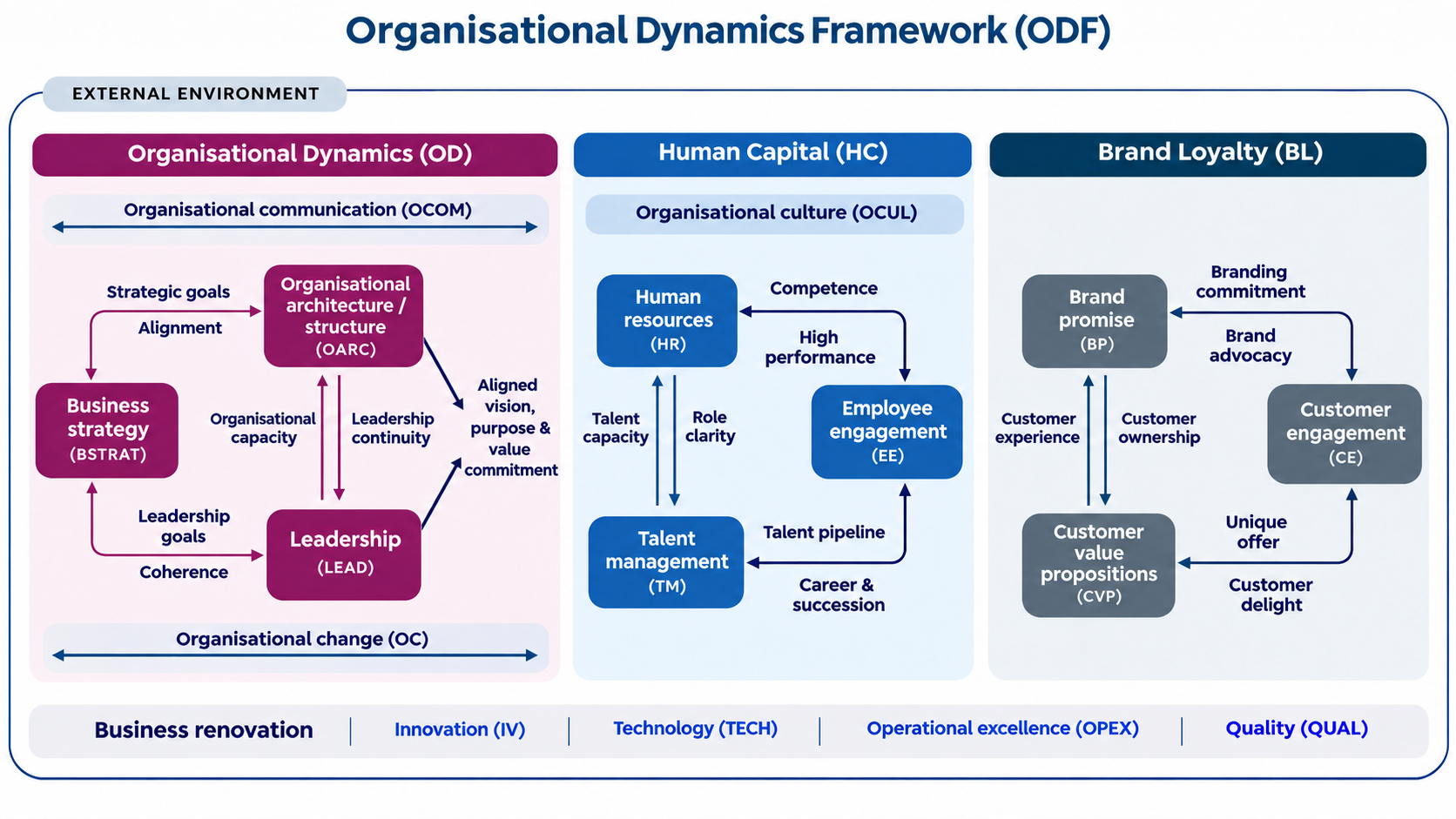
Organisations rarely struggle because they completely lack strategy, talent, leadership, technology or operational capability. More often, difficulty arises because these elements do not work effectively together. A business may have a compelling strategy but fail to communicate it. It may recruit exceptional people into structures that inhibit their contribution. It may invest in technology without changing the behaviours and processes required to realise its value. It may achieve operational excellence while failing to translate that capability into a compelling customer experience. These are not necessarily isolated organisational problems. They may reflect the health of the wider organisational ecosystem. My doctoral research into organisational dynamics, human capital and brand loyalty led to the development of the Organisational Dynamics Framework (ODF) (See the ODF visual in the Appendix). The framework provides a way of understanding this interconnected ecosystem and how organisational conditions enable people to create value that ultimately reaches the customer.
From organisational performance to organisational health
Financial performance tells leaders something important about an organisation, but primarily about outcomes already produced. Organisational health asks a different question, i.e., how capable is the organisation of repeatedly producing sustainable performance? Systems thinking encourages managers to view organisations as interconnected wholes rather than collections of independent parts (Senge, 1990). Contemporary organisational health research similarly considers factors such as alignment, execution and organisational renewal in sustaining performance over time (De Smet et al., 2024). The ODF extends this thinking by examining the system connecting internal organisational conditions, human capability and behaviour, and external customer outcomes. Its central proposition is straightforward. Organisational outcomes rarely result from a single organisational variable; they emerge through the interaction of multiple variables across an interconnected ecosystem.
Twenty variables, one ecosystem
The ODF emerged from qualitative doctoral research examining how organisational dynamics enable human capital to deliver brand loyalty within a multinational global context of perishable agricultural goods. The interconnected themes are as follows, encompassing Organisational Dynamics, Organisational Communication, Business Strategy, Organisational Architecture, Leadership, Organisational Change, Human Capital, Organisational Culture, Human Resources, Talent Management, Employee Engagement; Brand Loyalty, Brand Promise, Customer Value Proposition and Customer Experience; together with the Macro Environment, Innovation, Technology, Operational Excellence and Quality. Most managers are familiar with these variables. The more significant insight lies in their interdependence. This was visible in the empirical findings. Analysis identified recurring co-occurrences between organisational themes. Leadership and Organisational Communication co-occurred 27 times. Quality and Brand Promise co-occurred 17 times, while Quality and Customer Experience co-occurred 10 times. Operational Excellence connected with Organisational Communication 14 times and with Business Strategy 11 times. These findings are not statistical correlations and do not establish causality. They demonstrate how participants’ experiences repeatedly connected these organisational phenomena. This helped conceptualise the organisation not as a collection of independent management disciplines, but as an interconnected ecosystem.
Leadership becomes consequential through communication
The strongest observed relationship was between Leadership and Organisational Communication. Leadership is frequently treated as an individual capability, referring to the competence, judgement or behaviour of the leader. The findings suggest a broader interpretation. Leadership becomes organisationally consequential partly through how direction, meaning, expectations and priorities are communicated. A leader may possess strategic clarity personally, but unless they translate that clarity through communication, employees may experience ambiguity rather than direction. This illustrates an important ecosystem principle in that the effectiveness of one organisational variable may depend on the health of another. The leadership question therefore moves beyond, “Do we have capable leaders?” towards “Does our leadership system create sufficient clarity, communication and alignment for people to act effectively?”
Quality ultimately reaches the customer
A second important relationship involved Quality, Brand Promise and Customer Experience. Quality is often positioned as an operational responsibility involving standards, specifications, compliance and process control. The ODF findings suggest its organisational significance extends further. Participants connected Quality with both Brand Promise and Customer Experience. Customers do not see an organisation’s internal quality-management system; they experience its consequences. When quality is delivered consistently, the organisation is better positioned to fulfil its brand promise. When quality becomes inconsistent, the disconnect may become visible in the customer experience. The marketing function does not deliver the brand promise alone. The organisational ecosystem delivers it.
Operational excellence connects strategy to execution
A third pattern involved Operational Excellence, Business Strategy and Organisational Communication. Operational Excellence co-occurred with Business Strategy 11 times and Organisational Communication 14 times. While these findings do not establish causality, they illustrate how participants connected strategic intention with the organisation’s ability to communicate and execute it operationally. Strategy defines where an organisation intends to compete and how it proposes to create value. Operational excellence helps translate those intentions into consistent organisational activity, while communication provides a connective mechanism between them. This raises an important leadership question, i.e., is poor execution really an operational problem, or could it reflect a breakdown somewhere between strategy, communication and operations?
Human capital as the behavioural engine
This ecosystem perspective also explains the central position of human capital within the ODF. Strategies do not execute themselves. Organisational structures do not create customer experiences. Technology does not independently create innovation. Brand promises do not fulfil themselves. People translate organisational conditions into behaviour. Within the ODF, Organisational Dynamics can therefore be understood as creating enabling conditions, while Human Capital becomes the behavioural engine through which those conditions translate into organisational action. This helps explain why employee and customer experience should not be viewed as unrelated management agendas. Customers frequently encounter the organisation through the behaviour, decisions and capabilities of its people. The pathway to brand loyalty therefore begins well before the customer transaction. It begins inside the organisation.
Diagnosing relationships, not merely variables
The ecosystem perspective changes organisational diagnosis. Traditional dashboards can encourage leaders to view indicators independently, such as engagement is green, technology red and operational performance amber. Such reporting indicates where something may be happening without necessarily explaining why. The ODF encourages a second layer of inquiry. If communication is weak, what might this mean for leadership effectiveness and strategy execution? If quality deteriorates, where might the consequences appear in customer experience and the brand promise? If operational excellence weakens, should leaders examine operations alone, or also strategy and communication? The unit of analysis therefore becomes the relationship between variables, not merely the variable itself. This matters because organisational symptoms and organisational causes are not necessarily the same thing. Training more people or retraining people, for example, will not repair a system that prevents capable people from performing.
Seeing the whole organisation
The practical value of the ODF lies not in making every executive an organisational theorist, but in helping leaders ask better questions, like, Where is our ecosystem healthy? Where is it under strain? Which relationships are weakening? What downstream consequences might those weaknesses create? Ultimately, organisational health should not become an end in itself. A healthy organisation must create value. A customer may never see the organisation’s strategy, leadership model, talent architecture, culture, communication systems, quality processes or operating model. But the customer experiences their consequences. My research reinforces a simple proposition: organisational variables do not operate in isolation. Leadership appeared alongside communication; quality alongside brand promise and customer experience; and operational excellence alongside strategy and communication. Organisational ecosystem health emerges when these elements become mutually reinforcing rather than organisationally disconnected. Perhaps the most practical contribution of the Organisational Dynamics Framework is therefore also its simplest: Do not diagnose the organisational part without first understanding the organisational whole. For managers, leaders and coaches, that shift in perspective can change both the questions we ask and the interventions we choose. And better organisational questions are often where healthier organisations begin.