How internal alignment reaches the customer
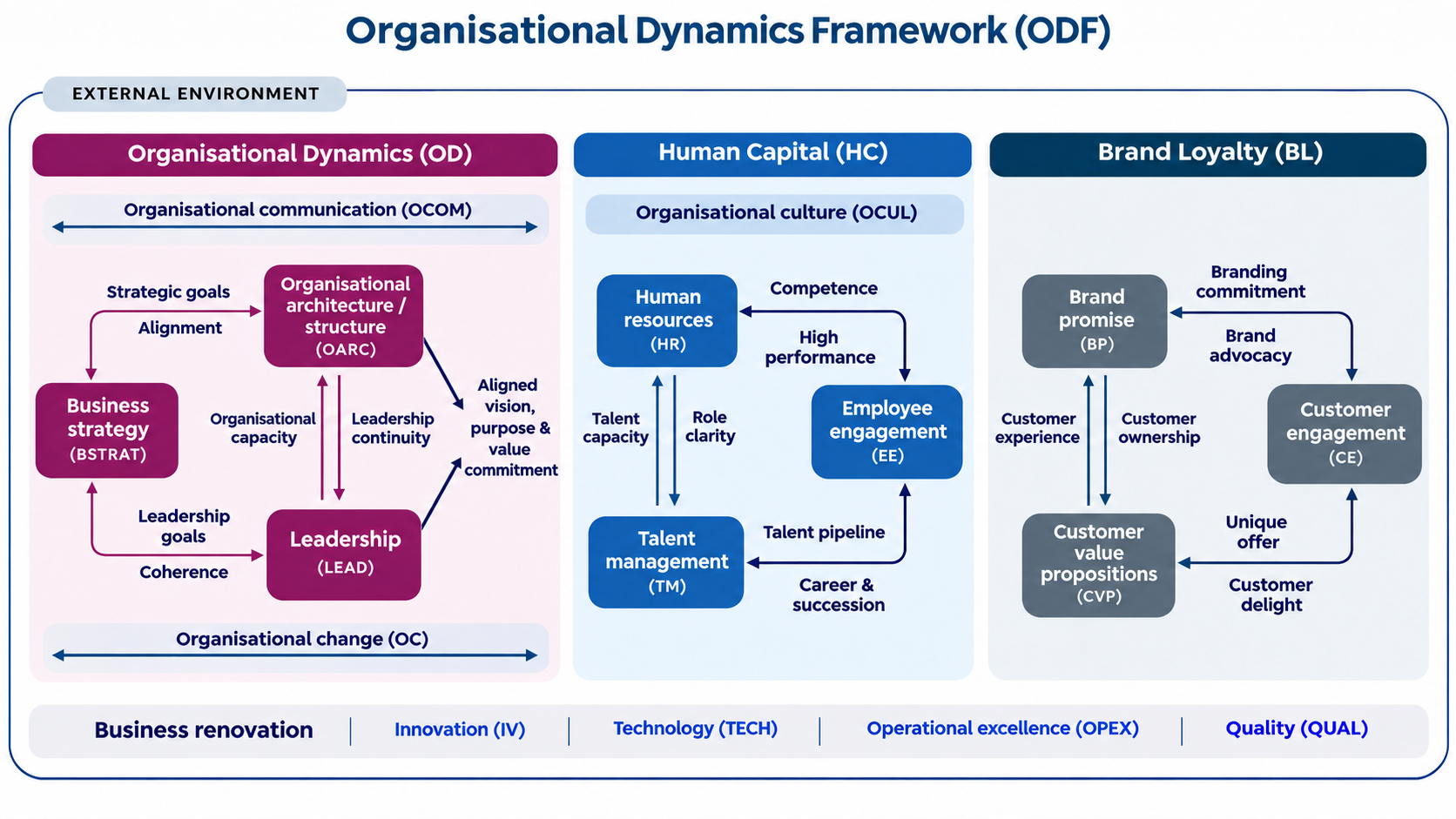
The Organisational Dynamics Framework (ODF) emerged from my doctoral research within a multinational fresh-fruit production and export group. The study explored how organisational dynamics enable human capital to support brand loyalty across a complex, multicultural value chain. It examined the relationships between internal organisational conditions and the experience delivered to customers.
The central proposition is that brand loyalty depends partly on what happens inside the organisation. Strategy, structure, leadership, culture and people systems shape employees’ ability to fulfil the brand promise. When these elements work together, customers are more likely to experience reliable service and consistent delivery. The framework offers leaders a way to examine those connections.
Three connected domains
The first domain, Organisational Dynamics, concerns the strategic and structural foundations of the organisation. It brings together business strategy, leadership, organisational architecture, communication and change. Together, these establish direction, clarify expectations and create the conditions in which people work.
The second domain, Human Capital, concerns the capabilities and human systems that translate strategic intent into action. Human resources, talent management, organisational culture and employee engagement influence whether people have the skills, role clarity and support to perform. Their contribution becomes visible in everyday decisions and behaviour.
The third domain, Brand Loyalty, concerns the customer-facing outcomes of those internal arrangements. It connects the brand promise, customer value proposition and customer engagement. Leaders can use this domain to ask whether the experience customers receive reflects the value the organisation intends to offer.
Enablers and the external environment
The three domains operate within a wider organisational ecosystem. Innovation, technology, operational excellence and quality support the organisation’s ability to renew itself and deliver consistently. External economic, political, technological and environmental conditions also influence what the organisation can achieve.
This context matters because an organisation cannot assess its internal alignment in isolation from its operating environment. A sound people strategy may still struggle when processes, technology or quality systems fail to support it. Equally, capabilities that worked well previously may require adjustment as customer expectations and market conditions change.
Putting the framework to work
The ODF can serve as a diagnostic lens, an integration framework and a guide to transformation. As a diagnostic lens, it helps leaders ask where strategy, leadership behaviour, employee experience and customer expectations have become disconnected. As an integration framework, it provides a shared language for human resources, operations and commercial teams to discuss their contribution to the brand promise.
For transformation, the framework encourages leaders to examine how a proposed intervention affects the wider system. A training initiative, for example, should be considered alongside role clarity, management support and the operational conditions in which employees will use their skills. The practical aim is to improve the connections that allow capability to become customer value.
The framework was developed in a multinational agricultural setting. Its relevance to other industries can be explored through further application and research, with attention to the differences between organisational contexts. Its immediate contribution is to help leaders connect what their organisation intends, how its people work and what its customers experience.